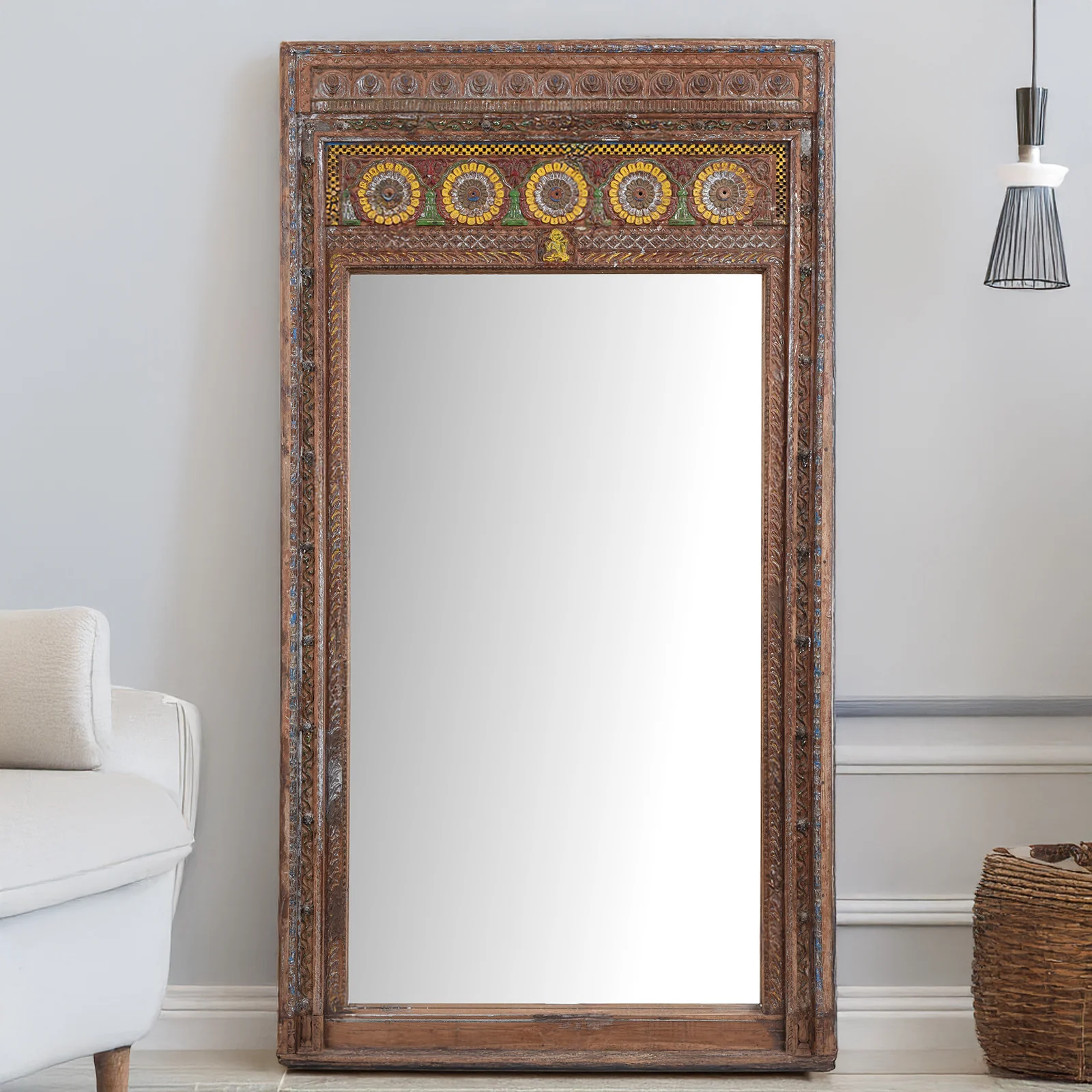
Painted Door Mirror From Shekhawati - 19th Century
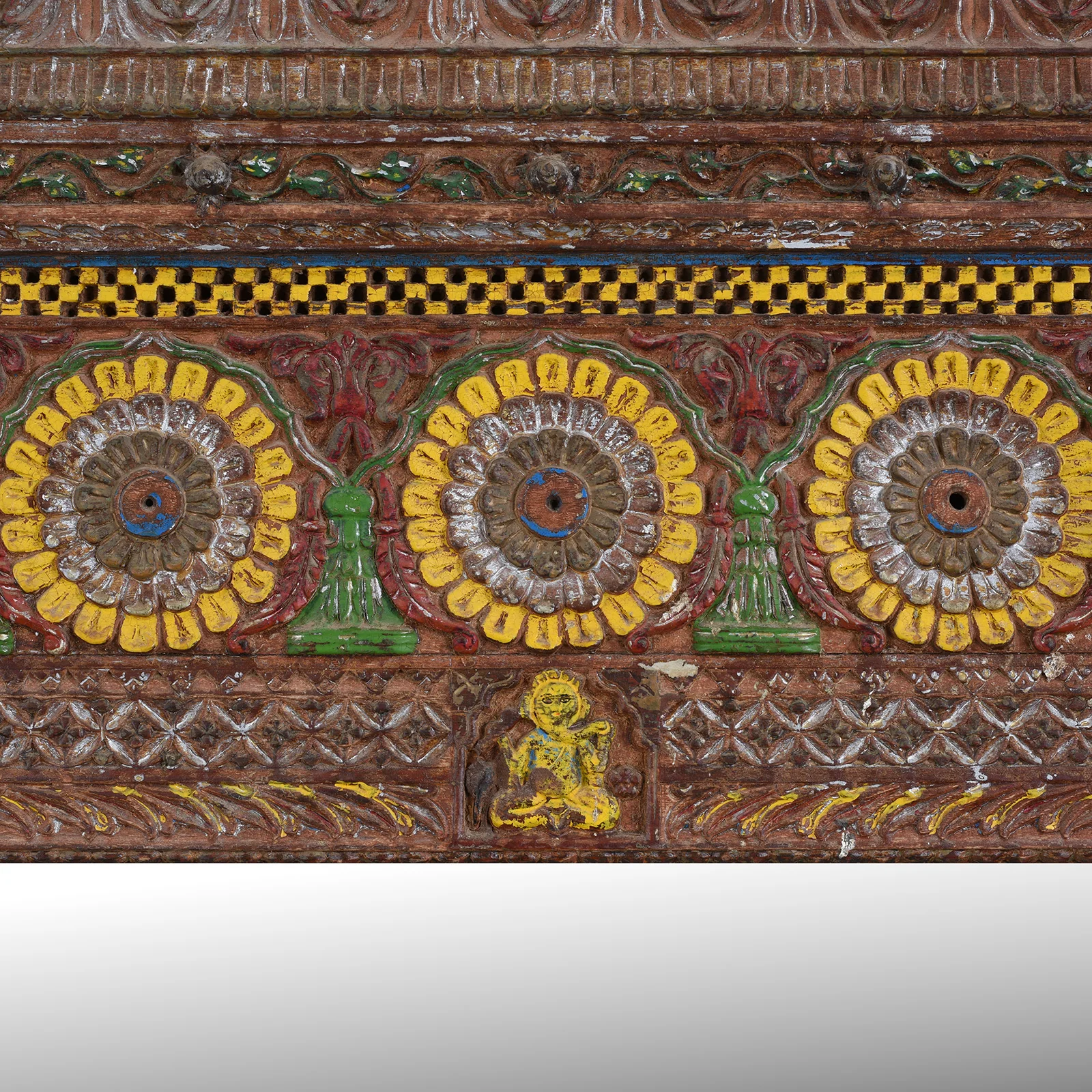
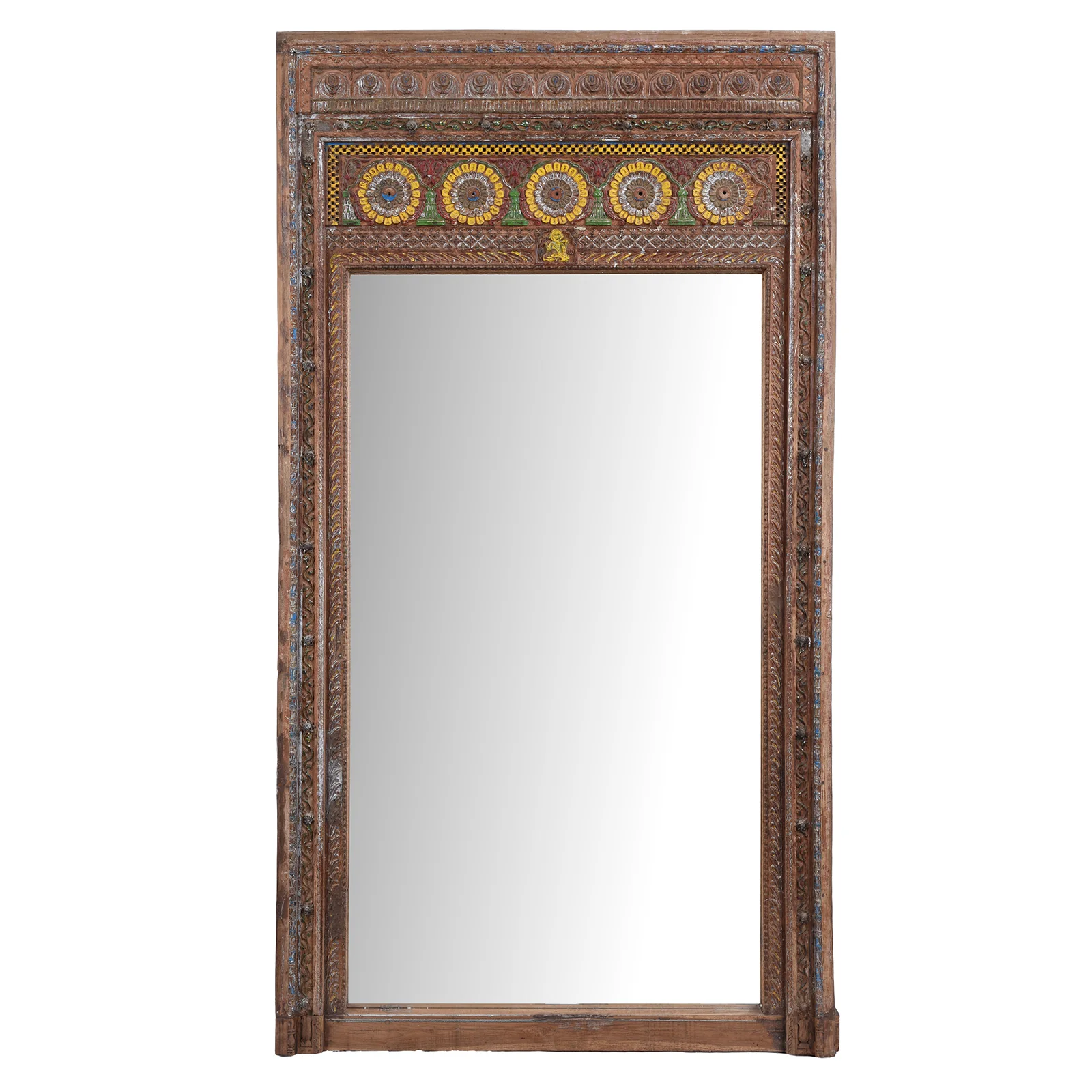
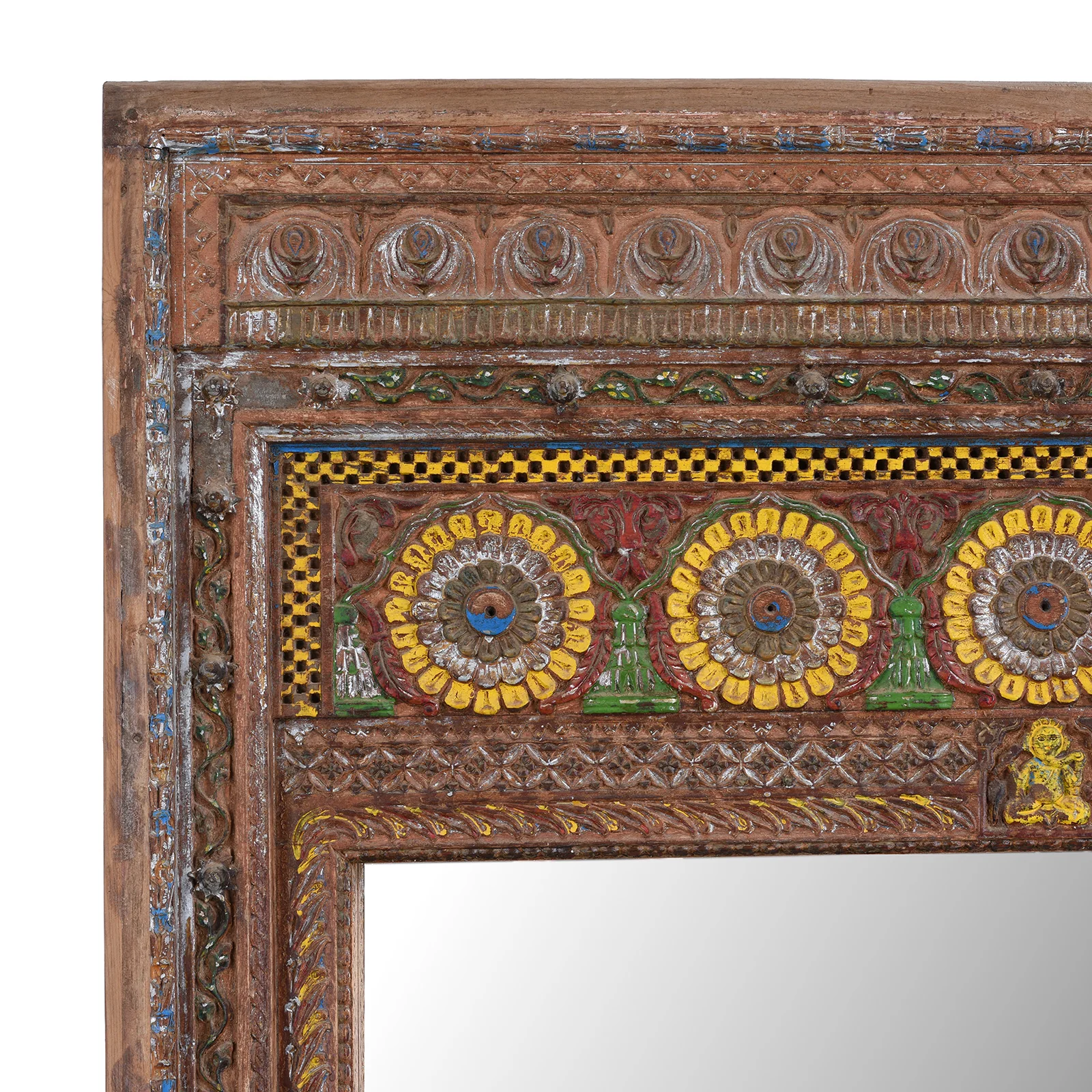
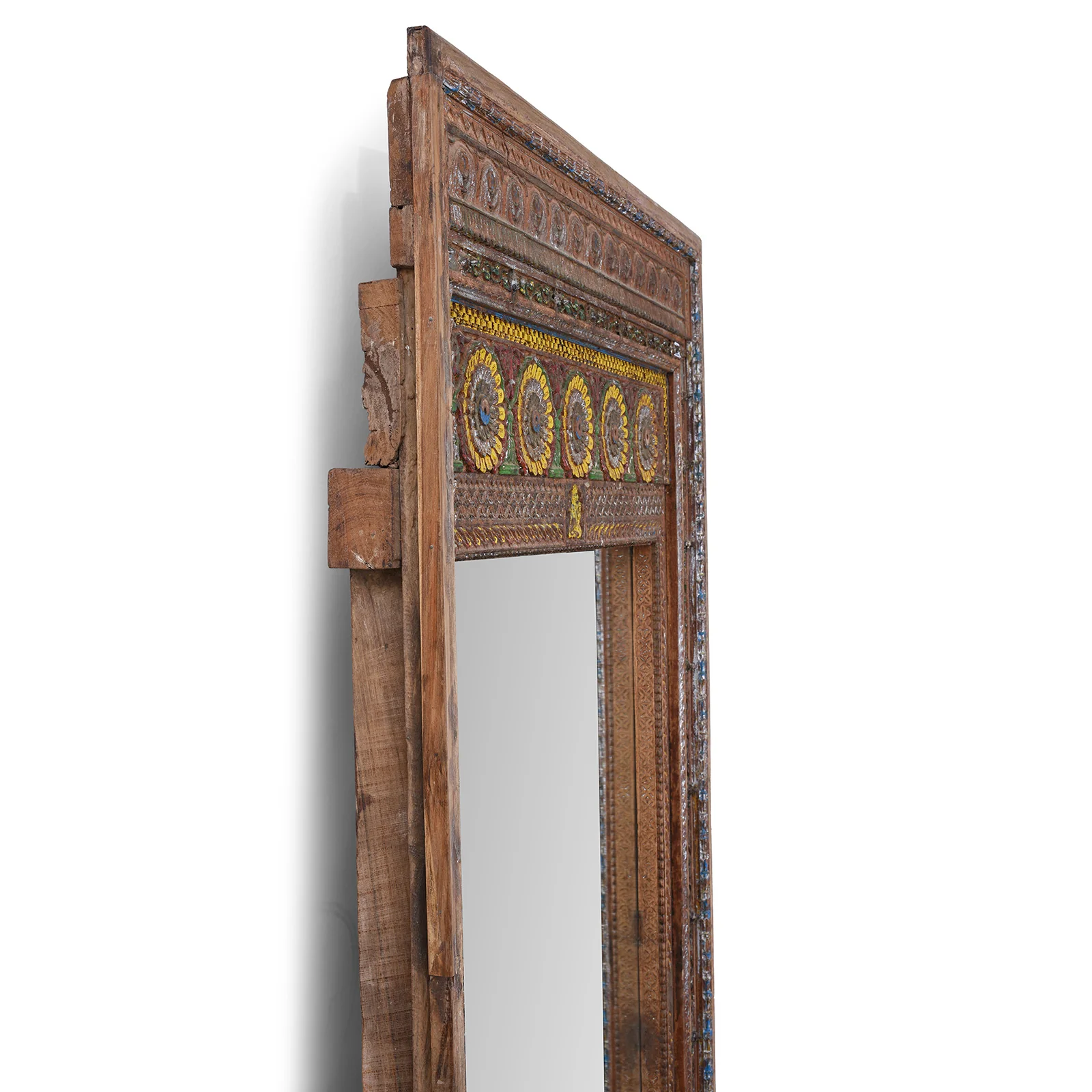
This exquisite mirror has been created from an early 19th-century Shekhawati teak door frame, originally part of a merchant haveli in northern Rajasthan. The frame displays the region’s distinctive combination of deep carving and vivid polychromy, with a frieze of stylised lotus medallions (padma) in yellow, red, and green pigments—traces of its original mineral paint still visible beneath a time-softened patina. At the centre of the lintel sits a finely carved figure of Ganesha, the auspicious guardian of thresholds, depicted beneath the lotus band in his traditional role as remover of obstacles and bestower of wisdom.
In Shekhawati architecture, this pairing of padma and Ganesha carried layered symbolic meaning. The lotus—its central padma-nābhi or “lotus-navel” representing the cosmic source of creation—signified purity, fertility, and divine emergence. The repetition of rosettes across the lintel formed a mandala-like rhythm symbolising harmony and cosmic order. Ganesha, placed below this celestial motif, sanctified the doorway, ensuring prosperity and success for all who entered the household. Together, these motifs encapsulate the Shekhawati ideal of art as both spiritual protection and display of worldly refinement.
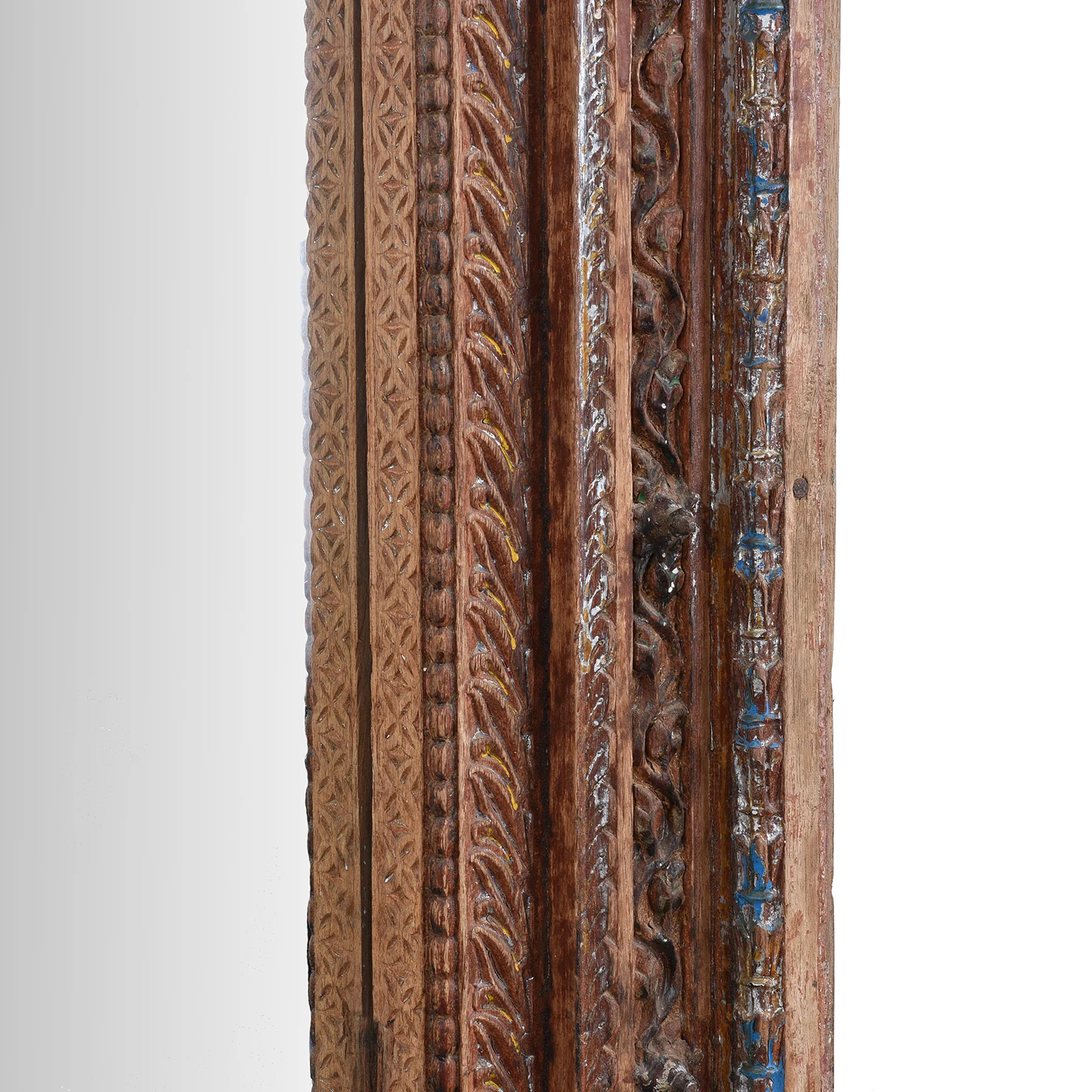
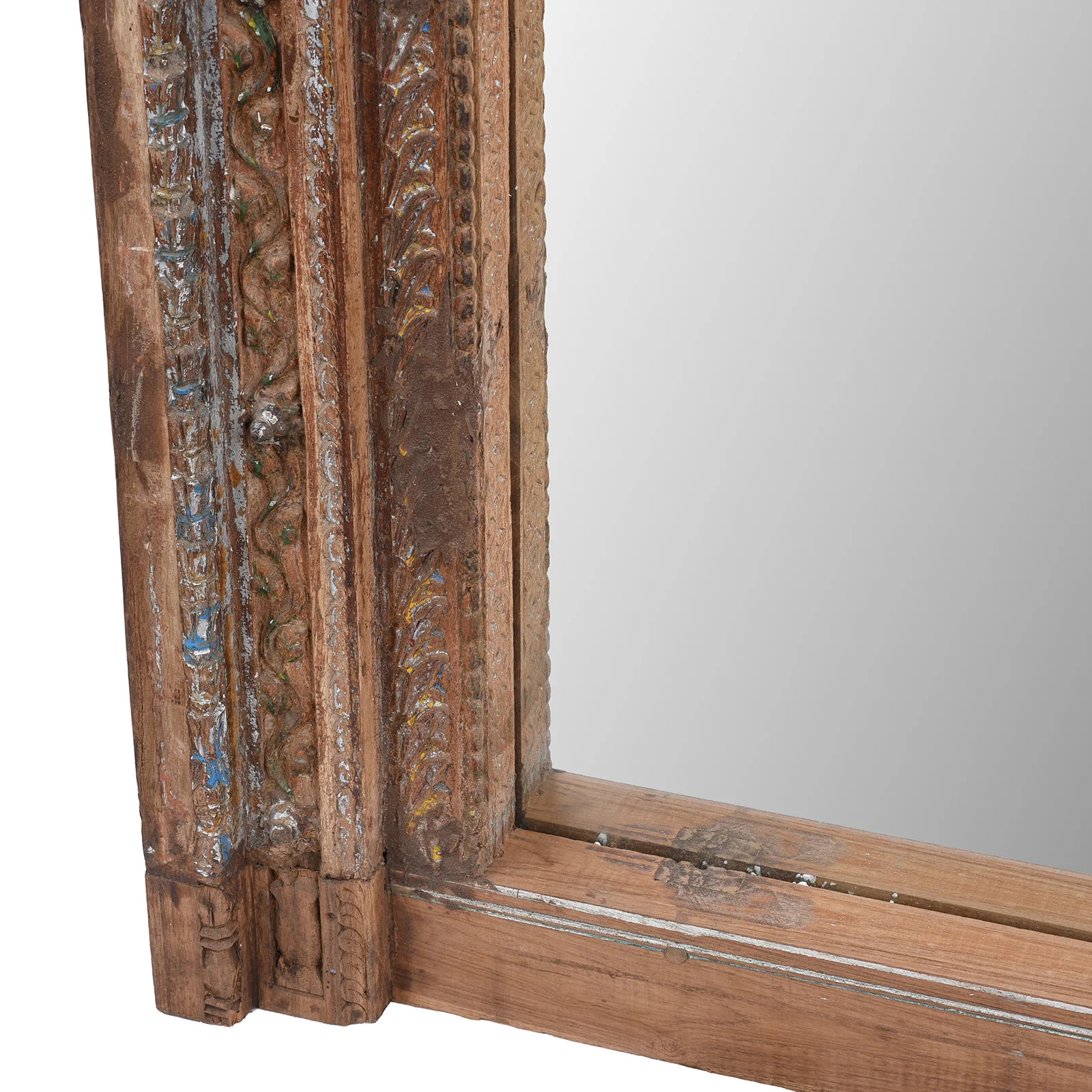
Carved from dense old teak, the frame retains rich textural depth and traces of original pigment in ochre, indigo, and green. It has been sensitively adapted with modern mirror glass, transforming it into a spectacular architectural statement piece suitable for an entranceway, dressing room, or interior wall. As with all Indigo’s reclaimed architectural mirrors, it is both authentic and environmentally conscious, preserving the artistry of 19th-century Rajasthan.
- Origin: Shekhawati region, Rajasthan, India
- Date: Early 19th Century
- Materials: Teak wood, mirror glass
- Features: Central Ganesha carving, row of stylised lotus (padma) medallions, traces of original Shekhawati pigments in yellow, green, and red, richly carved foliate and geometric borders
- Condition: Naturally aged surface with patina and pigment remains consistent with age; structurally sound
- Dimensions: W118 × D12 × H215 cm
Original: $2,082.54
-65%$2,082.54
$728.89More Images
Painted Door Mirror From Shekhawati - 19th Century
This exquisite mirror has been created from an early 19th-century Shekhawati teak door frame, originally part of a merchant haveli in northern Rajasthan. The frame displays the region’s distinctive combination of deep carving and vivid polychromy, with a frieze of stylised lotus medallions (padma) in yellow, red, and green pigments—traces of its original mineral paint still visible beneath a time-softened patina. At the centre of the lintel sits a finely carved figure of Ganesha, the auspicious guardian of thresholds, depicted beneath the lotus band in his traditional role as remover of obstacles and bestower of wisdom.
In Shekhawati architecture, this pairing of padma and Ganesha carried layered symbolic meaning. The lotus—its central padma-nābhi or “lotus-navel” representing the cosmic source of creation—signified purity, fertility, and divine emergence. The repetition of rosettes across the lintel formed a mandala-like rhythm symbolising harmony and cosmic order. Ganesha, placed below this celestial motif, sanctified the doorway, ensuring prosperity and success for all who entered the household. Together, these motifs encapsulate the Shekhawati ideal of art as both spiritual protection and display of worldly refinement.
Carved from dense old teak, the frame retains rich textural depth and traces of original pigment in ochre, indigo, and green. It has been sensitively adapted with modern mirror glass, transforming it into a spectacular architectural statement piece suitable for an entranceway, dressing room, or interior wall. As with all Indigo’s reclaimed architectural mirrors, it is both authentic and environmentally conscious, preserving the artistry of 19th-century Rajasthan.
- Origin: Shekhawati region, Rajasthan, India
- Date: Early 19th Century
- Materials: Teak wood, mirror glass
- Features: Central Ganesha carving, row of stylised lotus (padma) medallions, traces of original Shekhawati pigments in yellow, green, and red, richly carved foliate and geometric borders
- Condition: Naturally aged surface with patina and pigment remains consistent with age; structurally sound
- Dimensions: W118 × D12 × H215 cm
Product Information
Product Information
Shipping & Returns
Shipping & Returns
Description
This exquisite mirror has been created from an early 19th-century Shekhawati teak door frame, originally part of a merchant haveli in northern Rajasthan. The frame displays the region’s distinctive combination of deep carving and vivid polychromy, with a frieze of stylised lotus medallions (padma) in yellow, red, and green pigments—traces of its original mineral paint still visible beneath a time-softened patina. At the centre of the lintel sits a finely carved figure of Ganesha, the auspicious guardian of thresholds, depicted beneath the lotus band in his traditional role as remover of obstacles and bestower of wisdom.
In Shekhawati architecture, this pairing of padma and Ganesha carried layered symbolic meaning. The lotus—its central padma-nābhi or “lotus-navel” representing the cosmic source of creation—signified purity, fertility, and divine emergence. The repetition of rosettes across the lintel formed a mandala-like rhythm symbolising harmony and cosmic order. Ganesha, placed below this celestial motif, sanctified the doorway, ensuring prosperity and success for all who entered the household. Together, these motifs encapsulate the Shekhawati ideal of art as both spiritual protection and display of worldly refinement.
Carved from dense old teak, the frame retains rich textural depth and traces of original pigment in ochre, indigo, and green. It has been sensitively adapted with modern mirror glass, transforming it into a spectacular architectural statement piece suitable for an entranceway, dressing room, or interior wall. As with all Indigo’s reclaimed architectural mirrors, it is both authentic and environmentally conscious, preserving the artistry of 19th-century Rajasthan.
- Origin: Shekhawati region, Rajasthan, India
- Date: Early 19th Century
- Materials: Teak wood, mirror glass
- Features: Central Ganesha carving, row of stylised lotus (padma) medallions, traces of original Shekhawati pigments in yellow, green, and red, richly carved foliate and geometric borders
- Condition: Naturally aged surface with patina and pigment remains consistent with age; structurally sound
- Dimensions: W118 × D12 × H215 cm