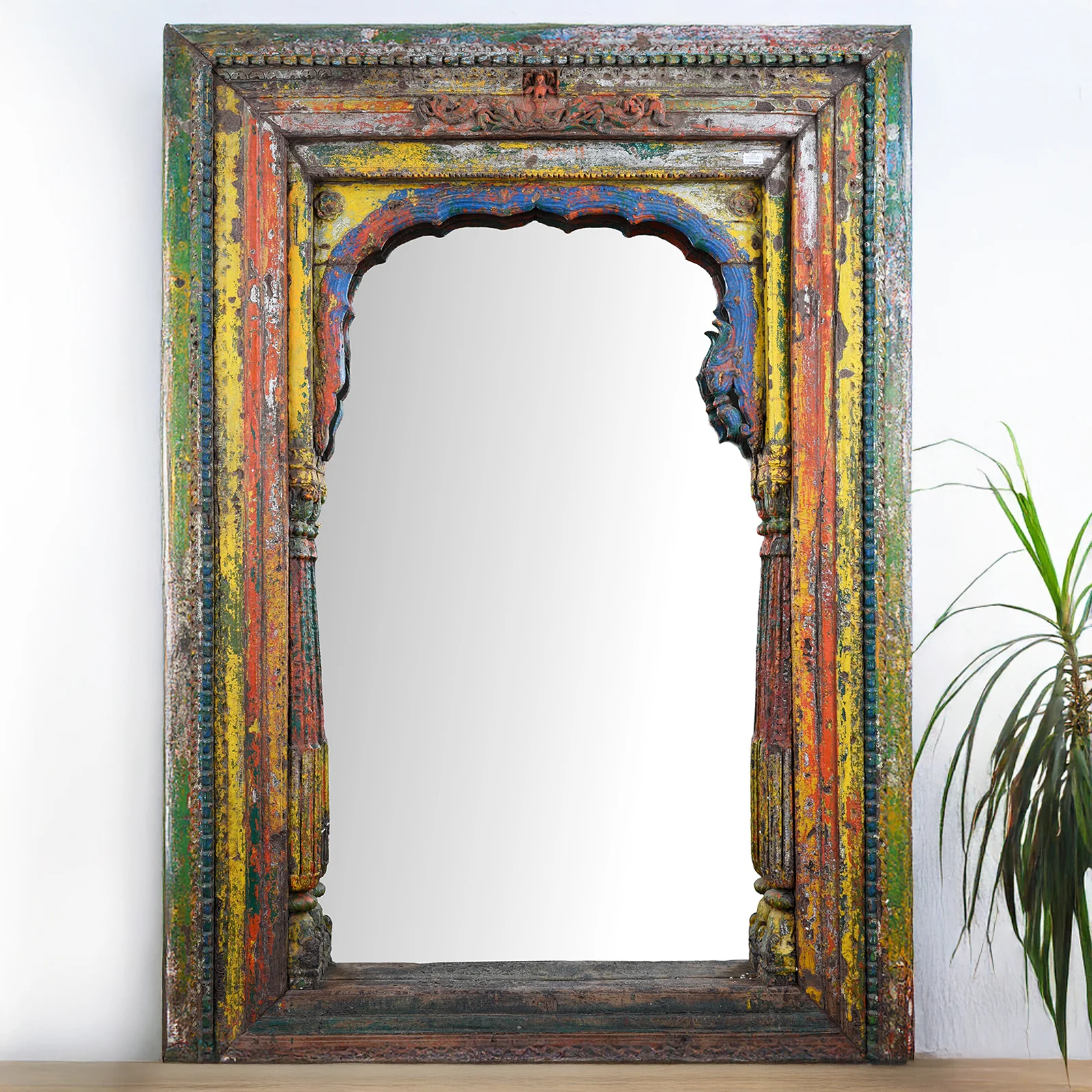
Painted Door Mirror From Andhra Pradesh - 19th Century
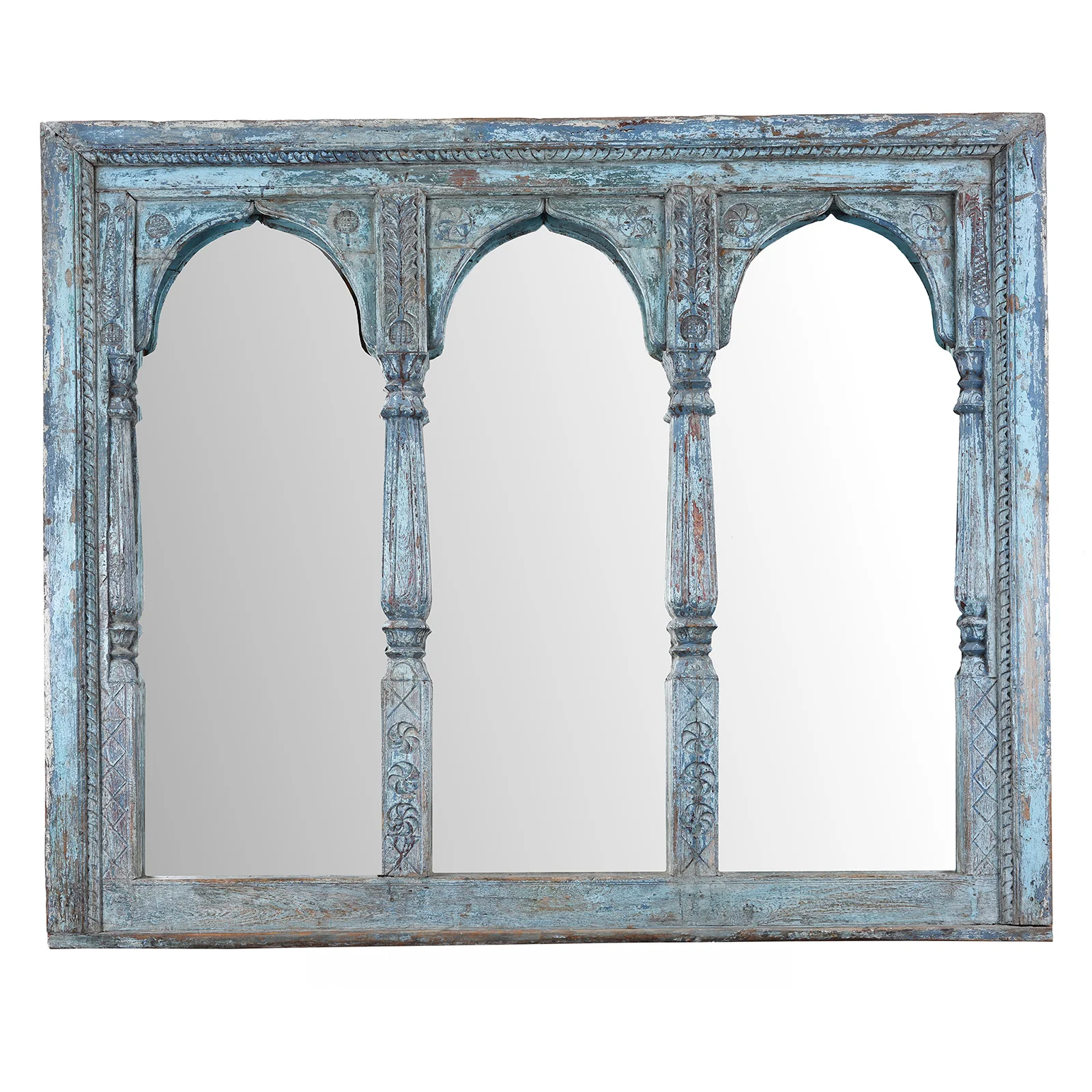
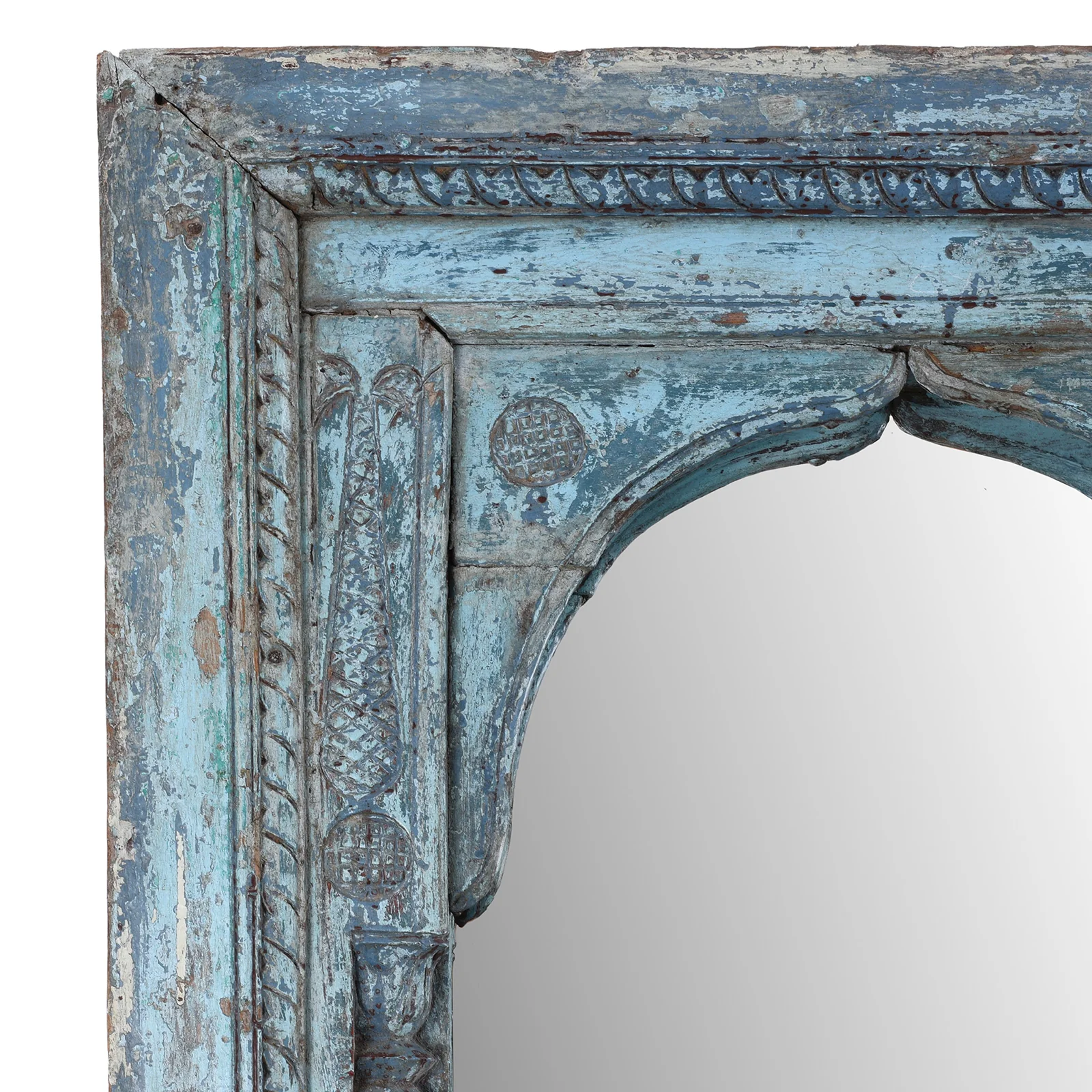
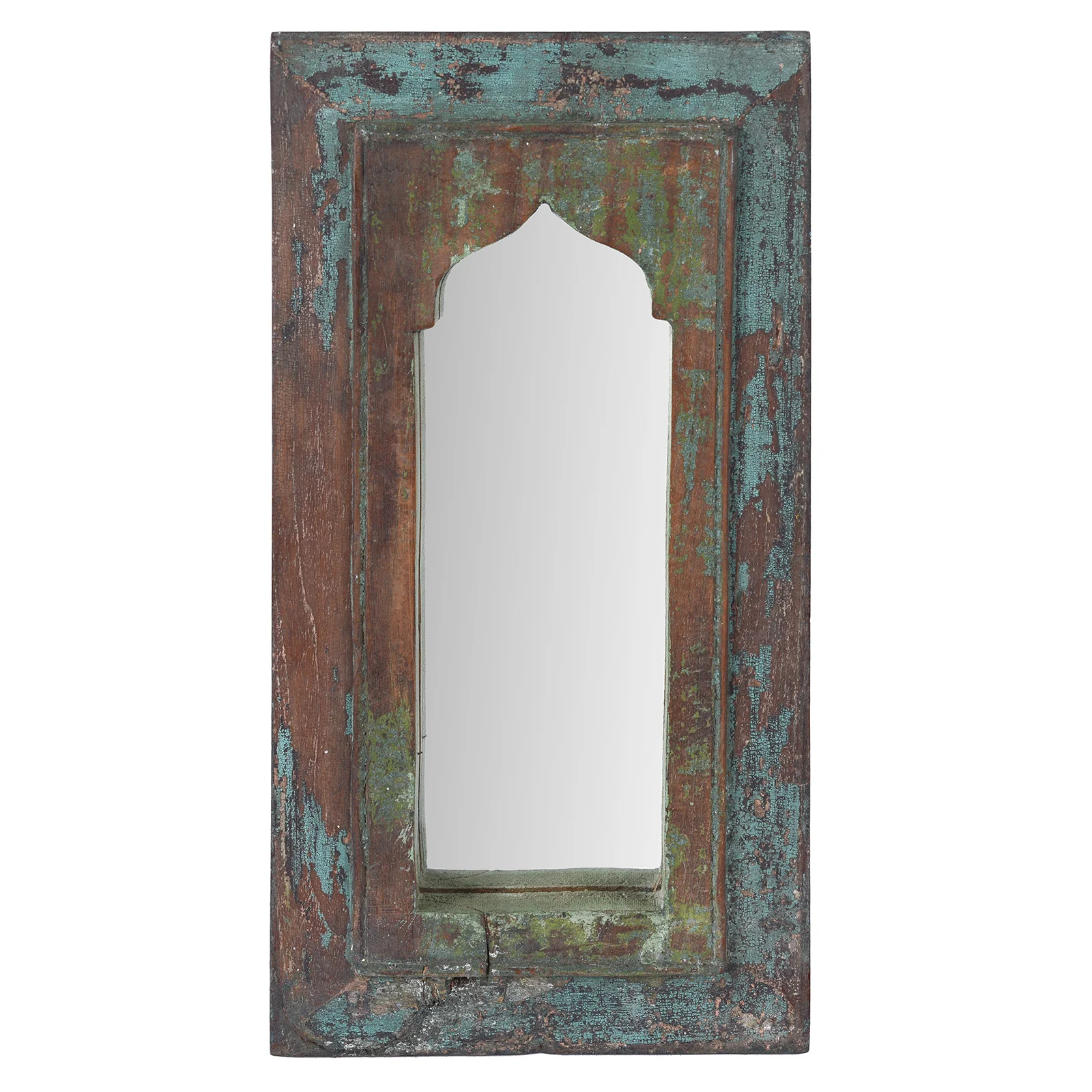
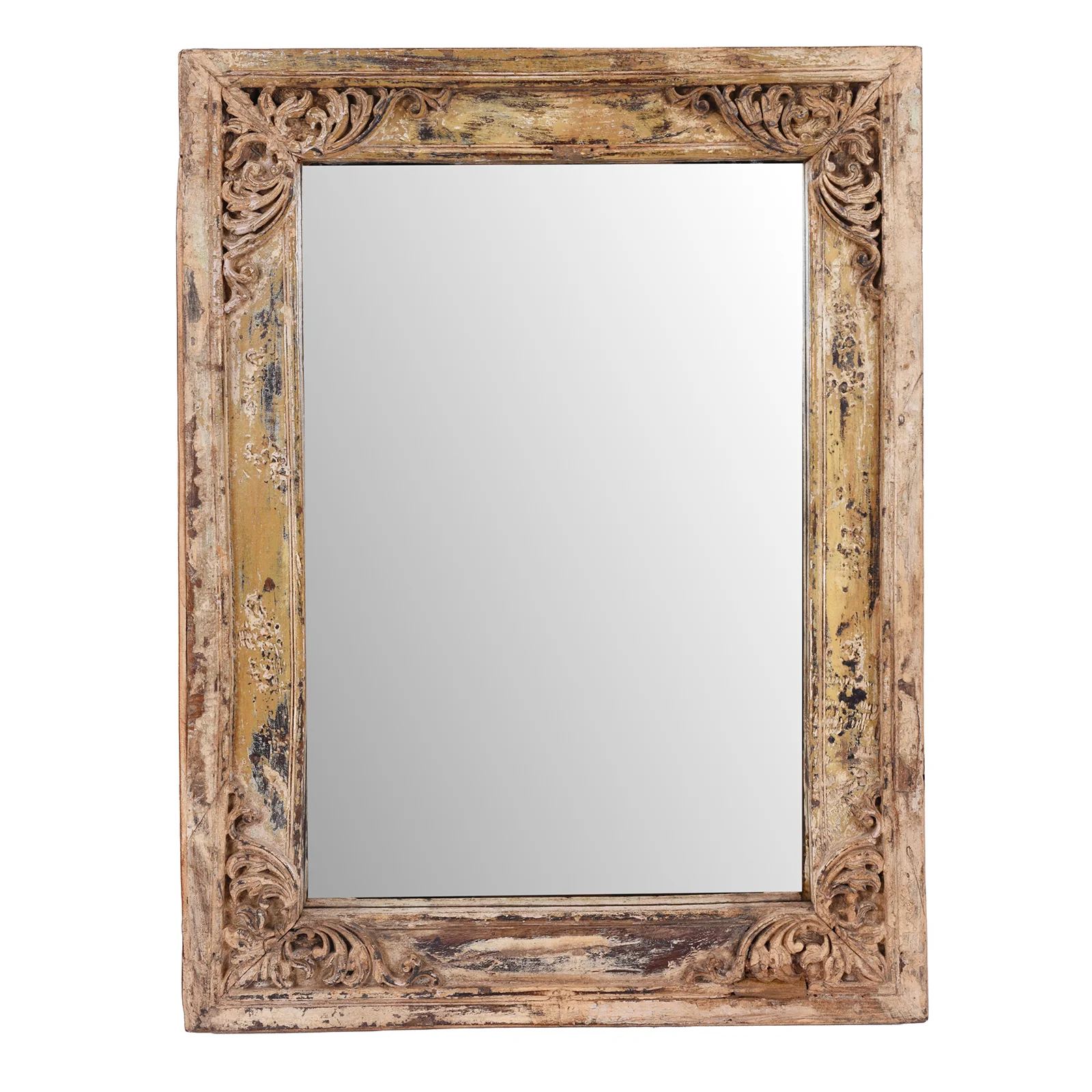
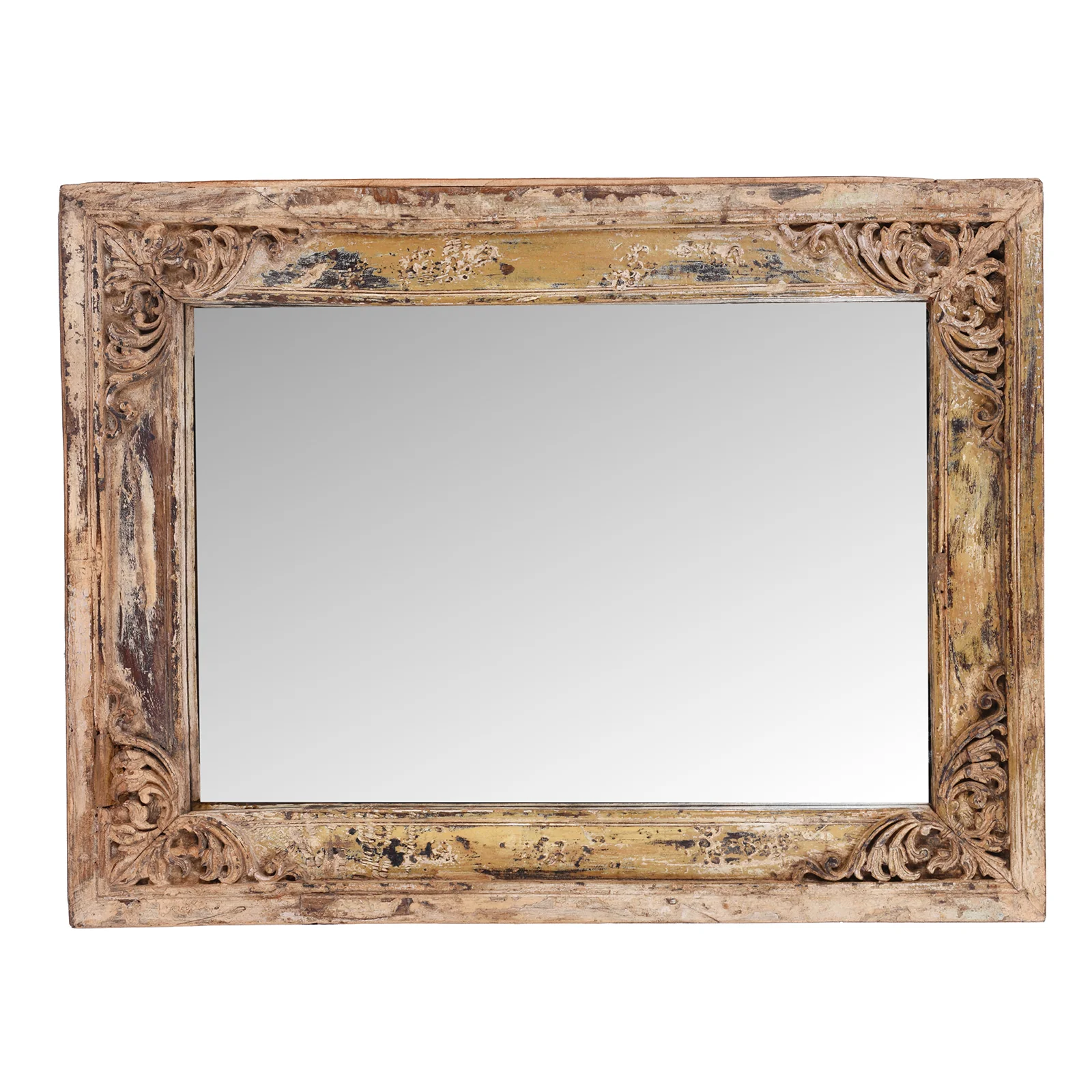
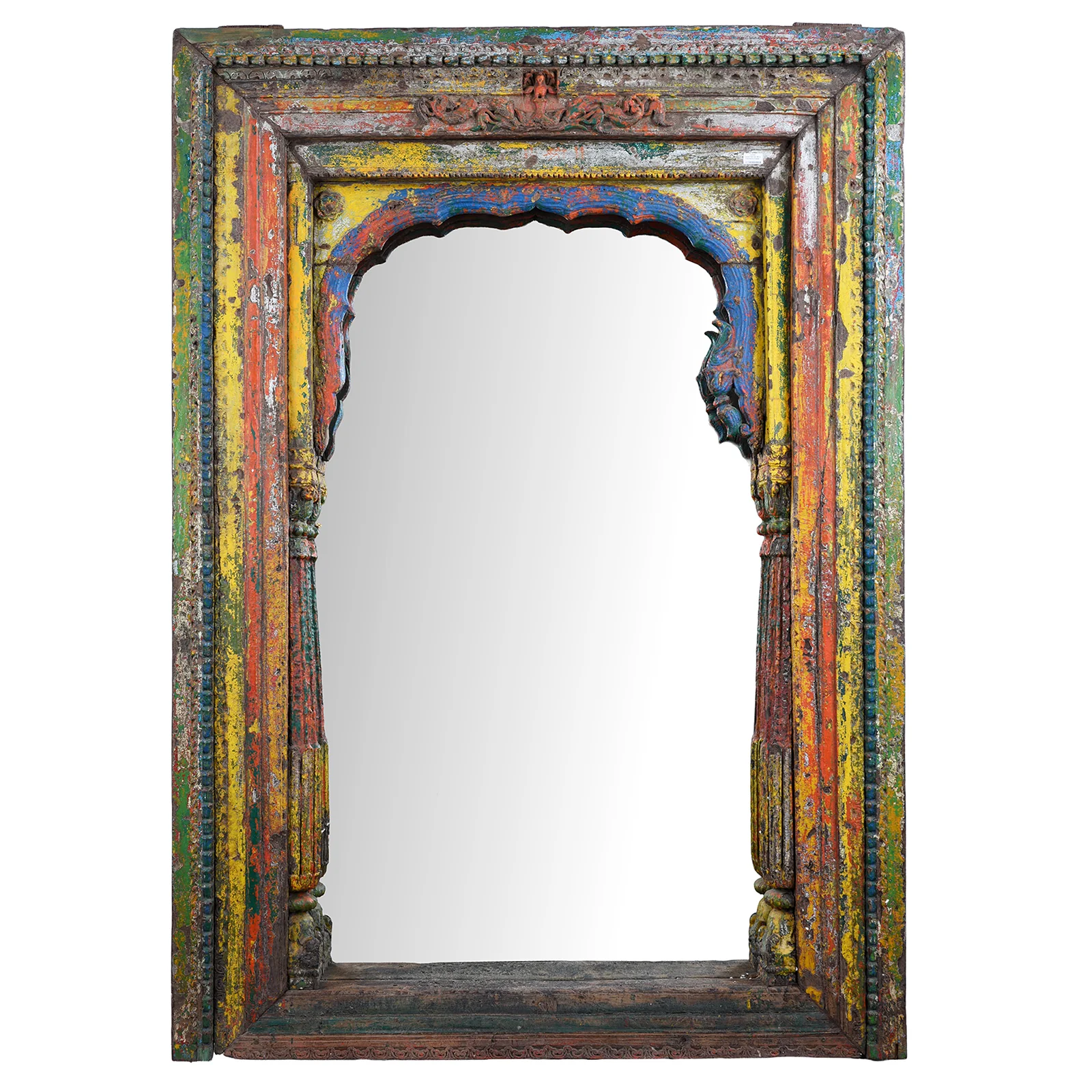
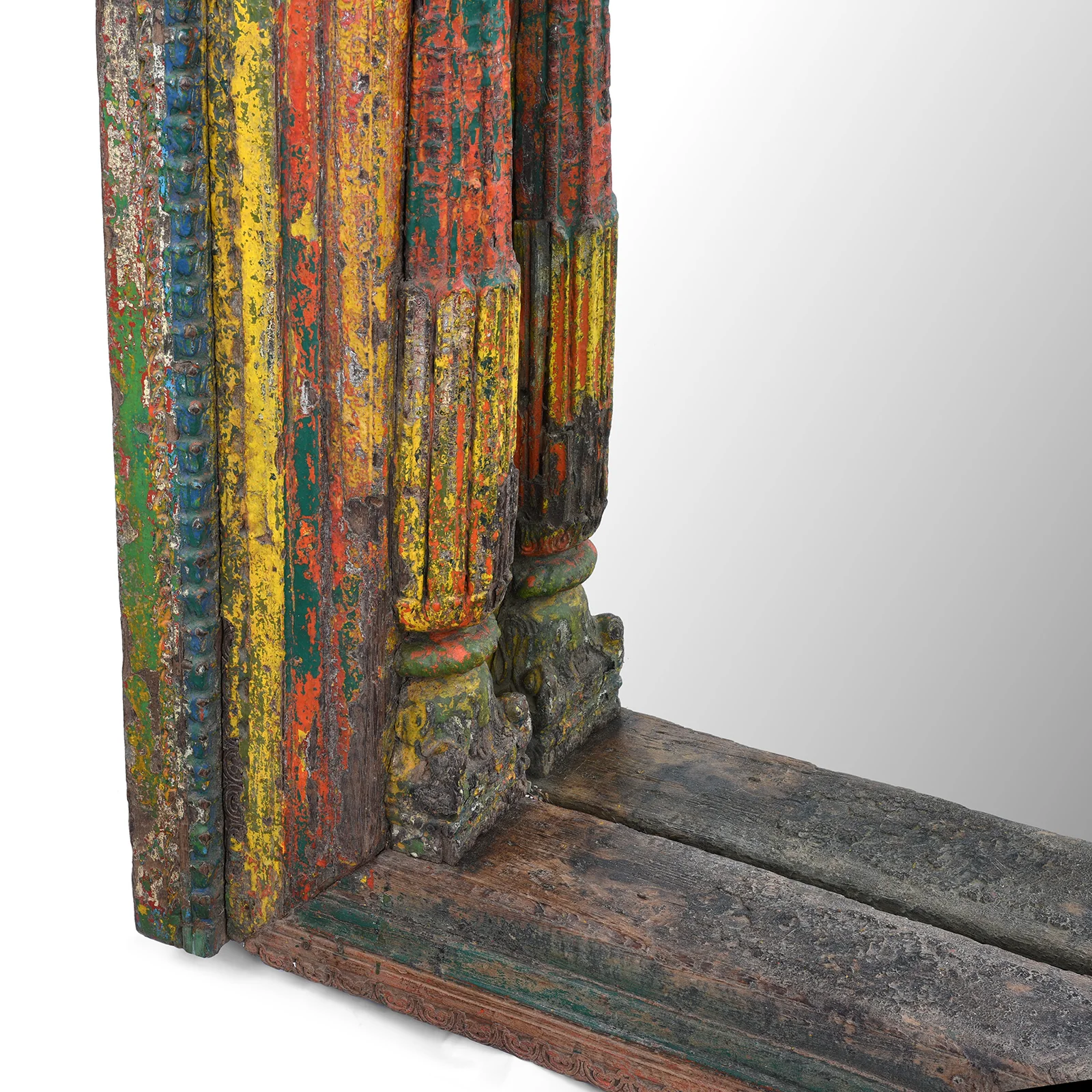
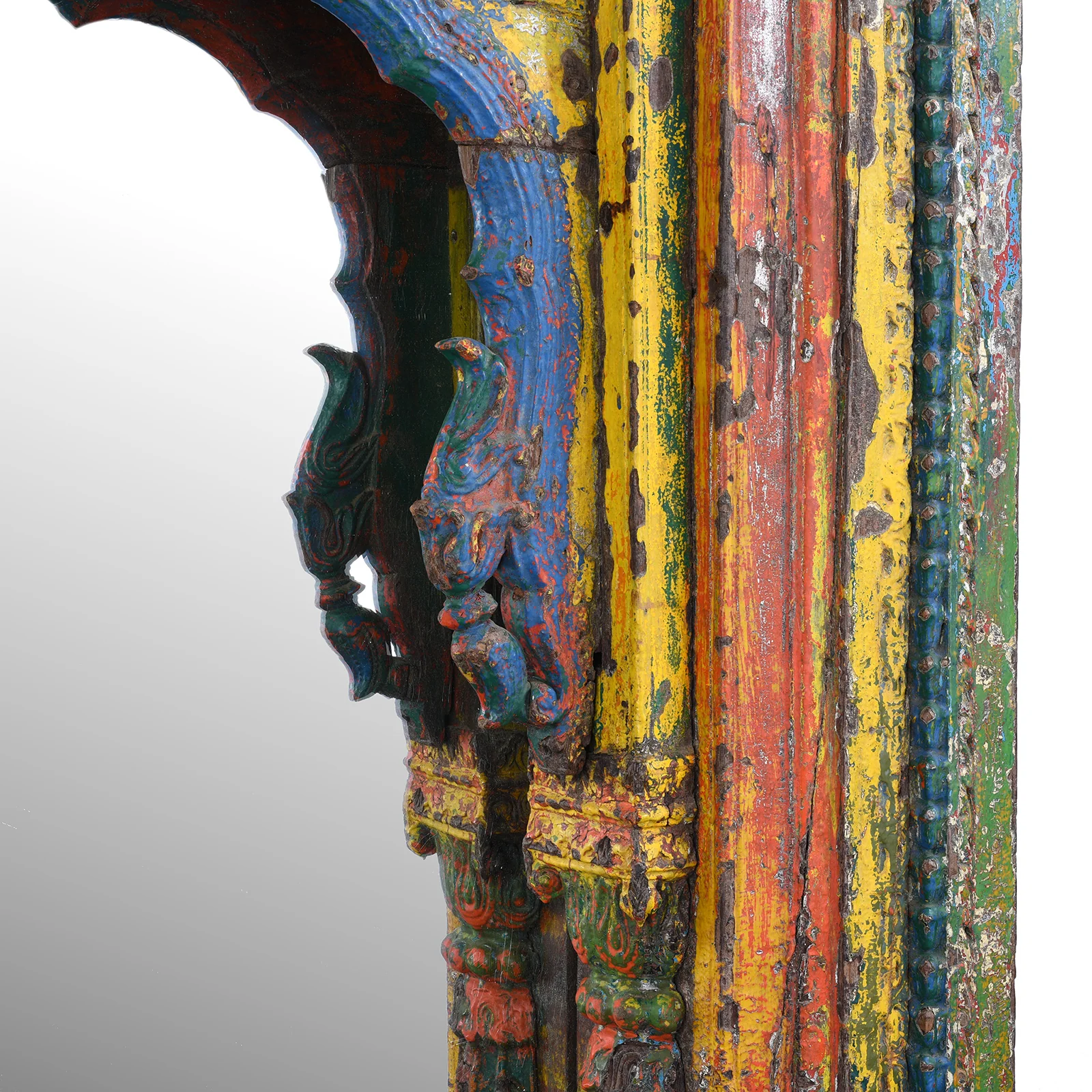
This striking mirror has been created from an original 19th-century carved teak door frame from Andhra Pradesh, displaying a distinctive Deccani–South Indian architectural style. The arched opening follows a graceful mihrab-inspired silhouette, supported by Corinthian-influenced column bases with fluted shafts and floral capitals. The surface shows successive generational layers of paint in vivid shades of yellow, red, green, and blue, forming a richly textured patina that celebrates decades of renewal and continued use.
The lintel is carved with a central peacock, flanked by stylised lotus blossoms (padma)—a pairing that carries deep symbolic meaning in Indian art. The peacock (mayūra) embodies beauty, immortality, and divine protection, while the lotus represents purity, creation, and spiritual transcendence. Their combination, common in Deccani and southern temple architecture, expresses the balance between the earthly and the divine—the peacock as the guardian of life’s splendour and the lotus as the cosmic source of creation (padma-nābhi).
Carved from dense old teak, the frame retains its architectural presence and sculptural depth. Adapted with modern mirror glass, it serves as a dramatic statement mirror, equally effective mounted to a wall or used as a substantial leaner piece. A superb example of 19th-century South Indian craftsmanship revitalised through careful preservation and sustainable reuse.
- Origin: Andhra Pradesh, India
- Date: Frame 19th Century; later paint mid–late 20th Century
- Materials: Teak wood, mirror glass
- Features: Central peacock flanked by stylised lotus motifs, mihrab-style arch, Corinthian-inspired pillars, layered later polychrome paint
- Condition: Structurally sound; surface shows aged, later paint layers and natural patina consistent with age
- Dimensions: W142 × D20 × H202 cm
Original: $3,779.08
-65%$3,779.08
$1,322.68More Images




Painted Door Mirror From Andhra Pradesh - 19th Century
This striking mirror has been created from an original 19th-century carved teak door frame from Andhra Pradesh, displaying a distinctive Deccani–South Indian architectural style. The arched opening follows a graceful mihrab-inspired silhouette, supported by Corinthian-influenced column bases with fluted shafts and floral capitals. The surface shows successive generational layers of paint in vivid shades of yellow, red, green, and blue, forming a richly textured patina that celebrates decades of renewal and continued use.
The lintel is carved with a central peacock, flanked by stylised lotus blossoms (padma)—a pairing that carries deep symbolic meaning in Indian art. The peacock (mayūra) embodies beauty, immortality, and divine protection, while the lotus represents purity, creation, and spiritual transcendence. Their combination, common in Deccani and southern temple architecture, expresses the balance between the earthly and the divine—the peacock as the guardian of life’s splendour and the lotus as the cosmic source of creation (padma-nābhi).
Carved from dense old teak, the frame retains its architectural presence and sculptural depth. Adapted with modern mirror glass, it serves as a dramatic statement mirror, equally effective mounted to a wall or used as a substantial leaner piece. A superb example of 19th-century South Indian craftsmanship revitalised through careful preservation and sustainable reuse.
- Origin: Andhra Pradesh, India
- Date: Frame 19th Century; later paint mid–late 20th Century
- Materials: Teak wood, mirror glass
- Features: Central peacock flanked by stylised lotus motifs, mihrab-style arch, Corinthian-inspired pillars, layered later polychrome paint
- Condition: Structurally sound; surface shows aged, later paint layers and natural patina consistent with age
- Dimensions: W142 × D20 × H202 cm
Product Information
Product Information
Shipping & Returns
Shipping & Returns
Description
This striking mirror has been created from an original 19th-century carved teak door frame from Andhra Pradesh, displaying a distinctive Deccani–South Indian architectural style. The arched opening follows a graceful mihrab-inspired silhouette, supported by Corinthian-influenced column bases with fluted shafts and floral capitals. The surface shows successive generational layers of paint in vivid shades of yellow, red, green, and blue, forming a richly textured patina that celebrates decades of renewal and continued use.
The lintel is carved with a central peacock, flanked by stylised lotus blossoms (padma)—a pairing that carries deep symbolic meaning in Indian art. The peacock (mayūra) embodies beauty, immortality, and divine protection, while the lotus represents purity, creation, and spiritual transcendence. Their combination, common in Deccani and southern temple architecture, expresses the balance between the earthly and the divine—the peacock as the guardian of life’s splendour and the lotus as the cosmic source of creation (padma-nābhi).
Carved from dense old teak, the frame retains its architectural presence and sculptural depth. Adapted with modern mirror glass, it serves as a dramatic statement mirror, equally effective mounted to a wall or used as a substantial leaner piece. A superb example of 19th-century South Indian craftsmanship revitalised through careful preservation and sustainable reuse.
- Origin: Andhra Pradesh, India
- Date: Frame 19th Century; later paint mid–late 20th Century
- Materials: Teak wood, mirror glass
- Features: Central peacock flanked by stylised lotus motifs, mihrab-style arch, Corinthian-inspired pillars, layered later polychrome paint
- Condition: Structurally sound; surface shows aged, later paint layers and natural patina consistent with age
- Dimensions: W142 × D20 × H202 cm