
Japanese Export Edo Chest - 18th Century
This Japanese Edo period lacquer chest dates to the late 17th to early 18th century (Edo period 1603–1868) and was produced for export during the era of Dutch trade through Dejima. High-quality Japanese export lacquer of this scale and survival is increasingly rare, particularly examples retaining their original decorated façade.
Constructed with an oak carcass specifically for overseas markets, the chest takes the form of a robust export trunk with substantial side carrying handles. The central lock plate and escutcheon are brass and European in influence, further reinforcing its intended destination outside Japan.
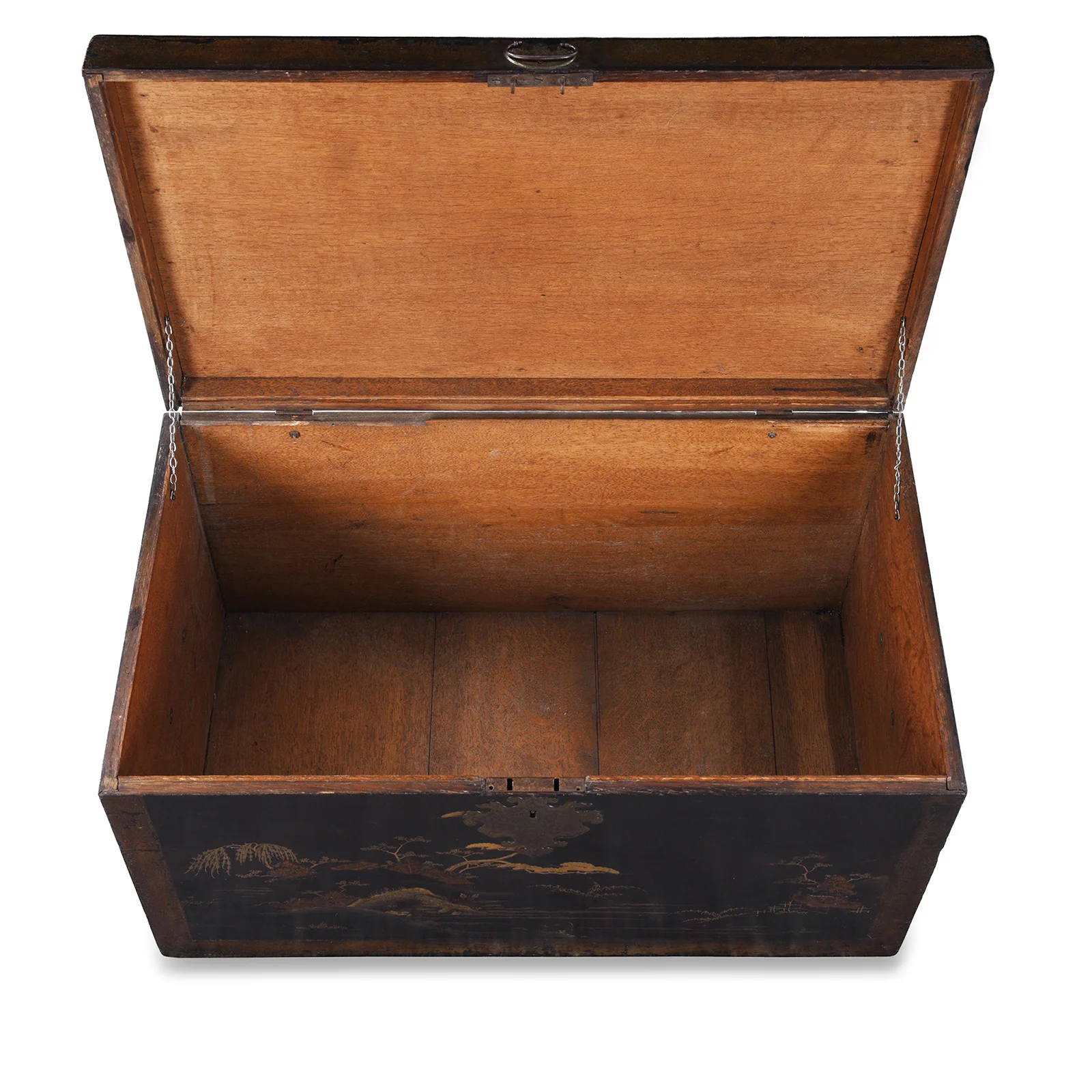
The front is finished in deep roiro-nuri black lacquer and decorated in gold takamaki-e with a Kano-school landscape. Rocky promontories rise from flowing water, pavilions sit within distant foliage, and wind-shaped trees animate the composition. The raised gold relief is confidently modelled yet restrained, standing in deliberate contrast against the polished black ground. The disciplined spacing and controlled ornament are characteristic of late 17th century Japanese export lacquer at its most refined.
The lid has been historically replaced following earlier damage, a period alteration consistent with the long working life of export chests. The interior reveals warm oak construction and remains structurally sound.
- Origin: Japan
- Date: Edo Period (1603–1868), late 17th to early 18th century
- Materials: Oak carcass, roiro black lacquer, gold takamaki-e, brass fittings
- Type: Japanese export lacquer chest
- Decoration: Kano-school landscape in raised gold lacquer
- Condition: Very good antique condition with age-related wear. Lid historically replaced. Restored in our UK workshops.
Original: $5,460.76
-65%$5,460.76
$1,911.27More Images




Japanese Export Edo Chest - 18th Century
This Japanese Edo period lacquer chest dates to the late 17th to early 18th century (Edo period 1603–1868) and was produced for export during the era of Dutch trade through Dejima. High-quality Japanese export lacquer of this scale and survival is increasingly rare, particularly examples retaining their original decorated façade.
Constructed with an oak carcass specifically for overseas markets, the chest takes the form of a robust export trunk with substantial side carrying handles. The central lock plate and escutcheon are brass and European in influence, further reinforcing its intended destination outside Japan.
The front is finished in deep roiro-nuri black lacquer and decorated in gold takamaki-e with a Kano-school landscape. Rocky promontories rise from flowing water, pavilions sit within distant foliage, and wind-shaped trees animate the composition. The raised gold relief is confidently modelled yet restrained, standing in deliberate contrast against the polished black ground. The disciplined spacing and controlled ornament are characteristic of late 17th century Japanese export lacquer at its most refined.
The lid has been historically replaced following earlier damage, a period alteration consistent with the long working life of export chests. The interior reveals warm oak construction and remains structurally sound.
- Origin: Japan
- Date: Edo Period (1603–1868), late 17th to early 18th century
- Materials: Oak carcass, roiro black lacquer, gold takamaki-e, brass fittings
- Type: Japanese export lacquer chest
- Decoration: Kano-school landscape in raised gold lacquer
- Condition: Very good antique condition with age-related wear. Lid historically replaced. Restored in our UK workshops.
Product Information
Product Information
Shipping & Returns
Shipping & Returns
Description
This Japanese Edo period lacquer chest dates to the late 17th to early 18th century (Edo period 1603–1868) and was produced for export during the era of Dutch trade through Dejima. High-quality Japanese export lacquer of this scale and survival is increasingly rare, particularly examples retaining their original decorated façade.
Constructed with an oak carcass specifically for overseas markets, the chest takes the form of a robust export trunk with substantial side carrying handles. The central lock plate and escutcheon are brass and European in influence, further reinforcing its intended destination outside Japan.
The front is finished in deep roiro-nuri black lacquer and decorated in gold takamaki-e with a Kano-school landscape. Rocky promontories rise from flowing water, pavilions sit within distant foliage, and wind-shaped trees animate the composition. The raised gold relief is confidently modelled yet restrained, standing in deliberate contrast against the polished black ground. The disciplined spacing and controlled ornament are characteristic of late 17th century Japanese export lacquer at its most refined.
The lid has been historically replaced following earlier damage, a period alteration consistent with the long working life of export chests. The interior reveals warm oak construction and remains structurally sound.
- Origin: Japan
- Date: Edo Period (1603–1868), late 17th to early 18th century
- Materials: Oak carcass, roiro black lacquer, gold takamaki-e, brass fittings
- Type: Japanese export lacquer chest
- Decoration: Kano-school landscape in raised gold lacquer
- Condition: Very good antique condition with age-related wear. Lid historically replaced. Restored in our UK workshops.