
Bastar Goddess Figure From Chhattisgarh - Ca 1960
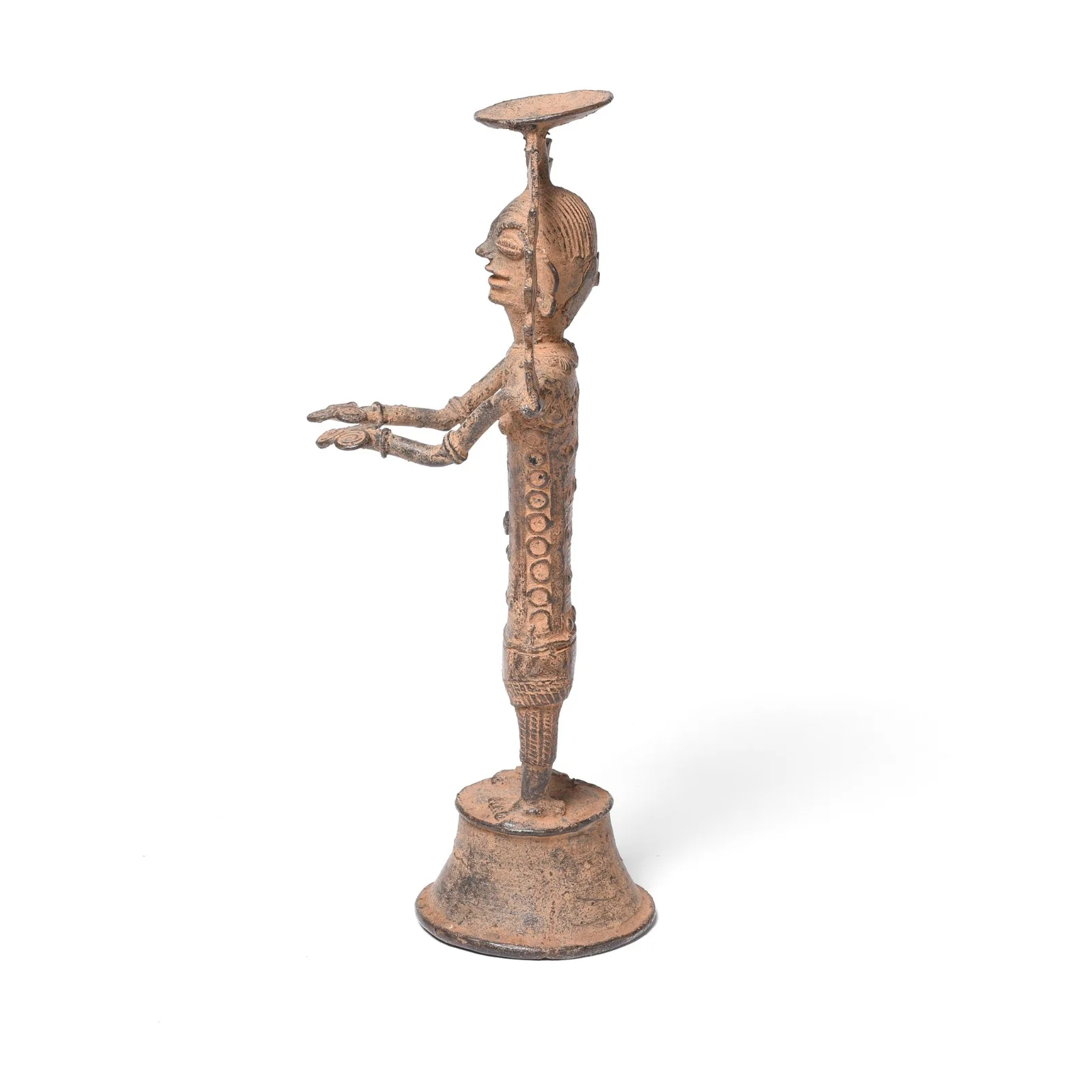
This Indian cast brass dhokra figure is almost certainly a mother goddess from the Bastar tribes of Chhattisgarh. Dating to the mid 20th century, the figure has a vadhi (the halo-like arch over their head) denoting their divine status as a god.
In Bastar culture, mother goddesses usually carry weapons and a vessel for drinking the blood of sacrificial victims. Male deities were predominantly associated with ancestor worship.
This brass figure was probably made by the Ghadva metalsmiths, also known as Ghasias. They make their dhokrawork using the dhokra / cire-perdue technique.
Dokra also spelled "Dhokra"- is a brass or bronze casting made using the lost wax technique. The process is commonly known as 'Cire Perdue.' The object to be cast is sculpted from beeswax mixed with a little oil. Once finished the entire figure is coated with clay made from termite hills to create the mould. The mould is dried and fired in an oven with cow-dung cakes. The wax melts leaving an empty clay mould in the shape to be cast. The mould is then heated and molten brass or bronze is poured into the empty clay mould. Once cool, the clay mould is broken exposing the cast bronze figure. The casting is then cleaned and finer details are carved to finish the piece.
References:
For similar examples see:
Museums of India 'National Handicrafts & Handlooms Museum New Delhi' by Jyotindra Jain & Aarti Aggarwal, page 31.
Change & Continuity: Folk & Tribal Art of India by Brian A Dursam, fig 277, 278 & 279.
UK Delivery Charge - except Highlands & Islands £7.50
More delivery options available at checkout
Original: $255.09
-65%$255.09
$89.28More Images


Bastar Goddess Figure From Chhattisgarh - Ca 1960
This Indian cast brass dhokra figure is almost certainly a mother goddess from the Bastar tribes of Chhattisgarh. Dating to the mid 20th century, the figure has a vadhi (the halo-like arch over their head) denoting their divine status as a god.
In Bastar culture, mother goddesses usually carry weapons and a vessel for drinking the blood of sacrificial victims. Male deities were predominantly associated with ancestor worship.
This brass figure was probably made by the Ghadva metalsmiths, also known as Ghasias. They make their dhokrawork using the dhokra / cire-perdue technique.
Dokra also spelled "Dhokra"- is a brass or bronze casting made using the lost wax technique. The process is commonly known as 'Cire Perdue.' The object to be cast is sculpted from beeswax mixed with a little oil. Once finished the entire figure is coated with clay made from termite hills to create the mould. The mould is dried and fired in an oven with cow-dung cakes. The wax melts leaving an empty clay mould in the shape to be cast. The mould is then heated and molten brass or bronze is poured into the empty clay mould. Once cool, the clay mould is broken exposing the cast bronze figure. The casting is then cleaned and finer details are carved to finish the piece.
References:
For similar examples see:
Museums of India 'National Handicrafts & Handlooms Museum New Delhi' by Jyotindra Jain & Aarti Aggarwal, page 31.
Change & Continuity: Folk & Tribal Art of India by Brian A Dursam, fig 277, 278 & 279.
UK Delivery Charge - except Highlands & Islands £7.50
More delivery options available at checkout
Product Information
Product Information
Shipping & Returns
Shipping & Returns
Description
This Indian cast brass dhokra figure is almost certainly a mother goddess from the Bastar tribes of Chhattisgarh. Dating to the mid 20th century, the figure has a vadhi (the halo-like arch over their head) denoting their divine status as a god.
In Bastar culture, mother goddesses usually carry weapons and a vessel for drinking the blood of sacrificial victims. Male deities were predominantly associated with ancestor worship.
This brass figure was probably made by the Ghadva metalsmiths, also known as Ghasias. They make their dhokrawork using the dhokra / cire-perdue technique.
Dokra also spelled "Dhokra"- is a brass or bronze casting made using the lost wax technique. The process is commonly known as 'Cire Perdue.' The object to be cast is sculpted from beeswax mixed with a little oil. Once finished the entire figure is coated with clay made from termite hills to create the mould. The mould is dried and fired in an oven with cow-dung cakes. The wax melts leaving an empty clay mould in the shape to be cast. The mould is then heated and molten brass or bronze is poured into the empty clay mould. Once cool, the clay mould is broken exposing the cast bronze figure. The casting is then cleaned and finer details are carved to finish the piece.
References:
For similar examples see:
Museums of India 'National Handicrafts & Handlooms Museum New Delhi' by Jyotindra Jain & Aarti Aggarwal, page 31.
Change & Continuity: Folk & Tribal Art of India by Brian A Dursam, fig 277, 278 & 279.
UK Delivery Charge - except Highlands & Islands £7.50
More delivery options available at checkout